Floma · Workflow Automation · Figma Plugin · 2025 – 2026
Enterprise marketing campaigns designed in minutes, not months
An AI-powered Figma automation system that turns generated content into hundreds of production-grade assets without sacrificing pixel-perfect brand control.
See the creative system behind these campaigns: Creative Intelligence →
8
Enterprise customers
200+
Assets per campaign
72hr
Delivery vs. six-week standard
Business Context
Delivering enterprise quality at AI speed
Floma's core offer was complete, production-ready campaign kits: finished work customers could review, revise, and ship, not concepts or wireframes. We delivered them in three business days instead of the six-week agency standard.
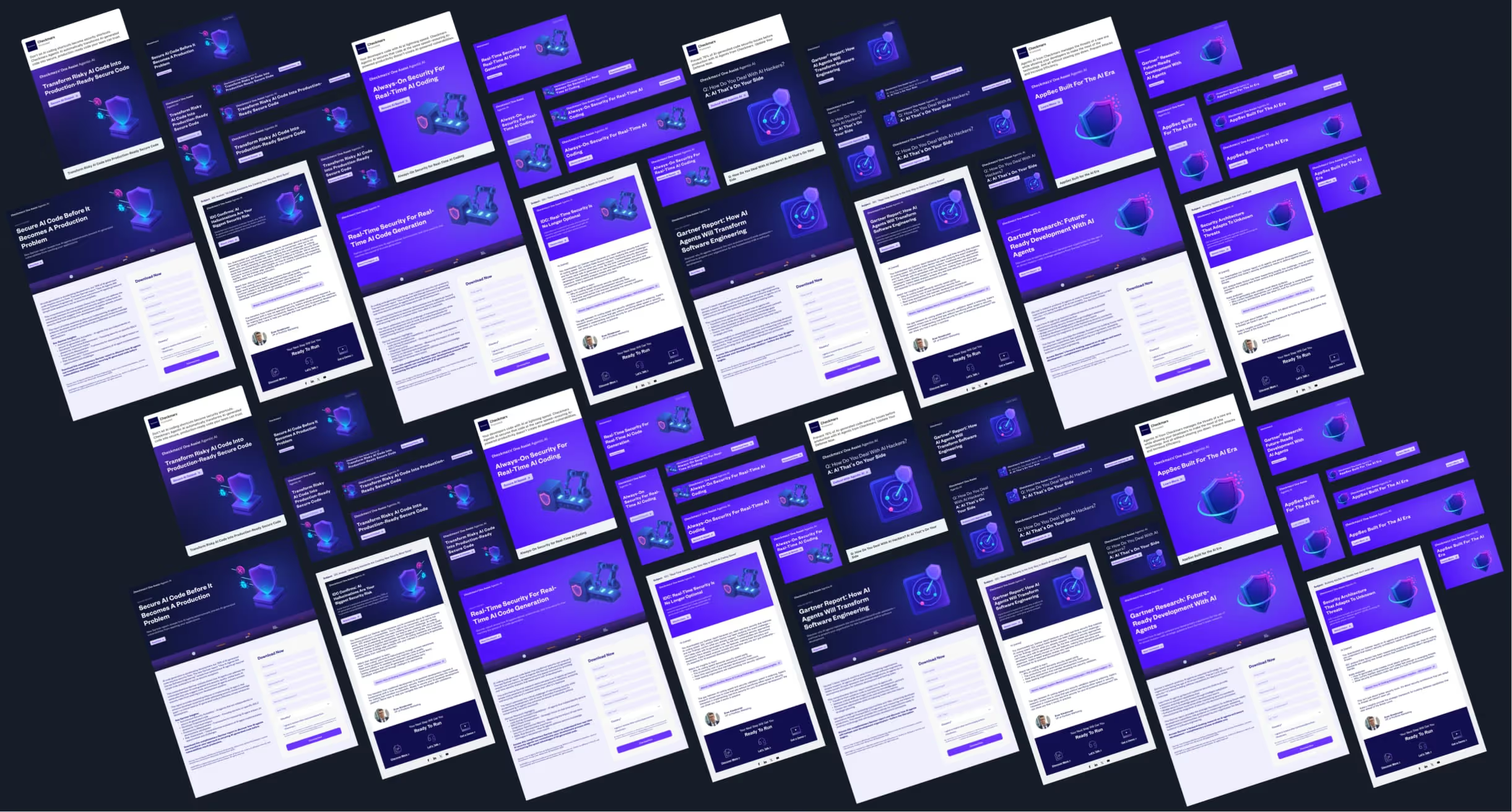
Each kit included hundreds of assets across formats: LinkedIn ads, display ads, motion graphics, emails, landing pages, blog posts. Ten fully realized concepts, the top three selected for launch. All within that three-day window.
For enterprise B2B companies, that meant meeting the same brand standards they expected from established agencies, just dramatically faster. The stakes were real. A single misaligned logo or wrong font weight could disqualify an entire campaign with a skeptical CMO.
Core Problem
Brand adherence, not approximation
Speed was the easy part. The harder problem was holding perfection at that speed.
Enterprise customers required exact brand assets: only approved logos, fonts, colors, and imagery. No AI interpretations, no close-enough approximations. Many had complex design systems with nuanced rules that took experienced designers to interpret. A single incorrect detail could invalidate an entire campaign with creative directors who were vocally skeptical of AI.
That was the bar, and it had to hold reliably across every client, at the pace the business required.
Research and Insights
Why generative AI wasn't the only answer
The obvious approach was full AI image generation. There was no shortage of hype, and I needed to know whether it could actually meet enterprise standards at scale.
I tested GPT-Image, Gemini, and BFL Flux against the criteria that matter to experienced designers working with strict brand systems: brand fidelity, layout precision, repeatability, and fine-grained control. The results looked promising to non-designers, which is part of why these tools gained early traction. That was the most dangerous part: outputs that passed casual review while still failing the expert scrutiny that enterprise review always involved.
Where "good enough" isn't good enough
To make the case clearly, I created an overlay comparison of a customer's actual brand assets against AI-generated versions. They looked similar at a glance. The overlay revealed geometry distortions, spacing inconsistencies, and proportion errors that would have ended the campaign. These are exactly the things a creative director catches immediately when their reputation is attached to the output.
This wasn't a subjective design preference. It was clear proof that one-shot generation couldn't deliver exact brand fidelity at scale. That artifact convinced the team and set the direction for everything that followed.
The randomness inherent in generative AI is an asset in many workflows. For assembly at enterprise scale, where pixel-perfect accuracy was non-negotiable, it was a liability. Generation still had a role in the workflow, just not here.
See how we used AI image generation in AI Creative Direction →
System Architecture
A hybrid system for deterministic assembly
The solution separated brand-critical decisions from AI-generated content. I architected a four-stage pipeline and spec'd a custom Figma plugin, built in close collaboration with Floma's Head of AI Agents, that assembled final assets in real time. Human judgment governed the brand layer; AI handled speed and variation. The result is a system where an LLM can autonomously select, populate, and assemble design system components into production-ready assets, at a scale and speed no manual workflow could match.
Four-stage pipeline: template → schema → content → assembly
-
Step 01
Template design
I build brand-specific Figma templates for each asset type, customized per customer after reviewing their brand guidelines and reference creative. A custom tagging grammar makes each template machine-readable, identifying text fields, nested structures, and component variables so the plugin knows exactly what to read, replace, and assemble.
-
Step 02
Schema authoring
The plugin scans the tagged template and generates a matching JSON schema, the contract between design intent and content generation. Field-level constraints like character count, tone, and capitalization ensure nothing arrives from the LLM that the assembly system doesn't expect.
-
Step 03
Content generation
The LLM produces campaign content constrained by those schemas. Every field arrives in exactly the format the assembly system expects, with no freeform output that could break the template structure.
-
Step 04
Asset assembly
The plugin reads the JSON output and assembles hundreds of complete, brand-perfect assets in seconds, applying content and design variables to every template simultaneously.
End-to-end assembly: one content generation produces every campaign asset, brand-perfect, in seconds
Managing Scale & Variability
Designed for variance, not just volume
No automation system handles every edge case. Rather than pursuing zero-touch automation, which would have been brittle, I designed the system to absorb most content variance automatically while preserving the control enterprise campaigns actually require.
Evolution & Impact
From fixed layouts to content-aware assembly
Fixed layout templates worked, but they had a real cost: visual homogeneity in long-form content and heavy upfront design work for each new asset type. The right fix was to raise the level at which AI operated, not to give it more visual freedom.
Instead of defining complete page templates, I defined a library of sections mapped to existing design system components. The LLM composes pages by selecting and ordering from that approved library, making layout decisions based on content while we maintain absolute control over every visual component it can use.
Section-based composition
This generalized the system to any asset type with an existing design system: SEO pages, product marketing, documentation. It's how we delivered dozens of unique SEO pages for Salesforce, with the LLM composing layouts from their design system components, exactly as an experienced designer would structure them.
Section-based assembly: the LLM composes complex layouts from a library of approved design system components
Outcome
Eight clients. Hundreds of assets. Forty-eight-hour turnaround.
8
Enterprise clients, from Series A to Fortune 500
200+
Production-ready assets in every campaign kit
72hr
Delivery from brief to ship-ready campaign
We used this system to deliver campaigns for five customers, from Series A startups like Allspice.io to Fortune 500 companies like Salesforce. Creative was unanimously approved across all of them, including from the most vocally skeptical creative directors.
What started as an internal workflow decision became a differentiator in sales conversations. Enterprise customers were wary of AI-generated creative that might not survive expert review. The ability to promise exact brand adherence rather than approximation was a trust signal that generic AI ad generators couldn't match.
The system proved that deterministic assembly could meet enterprise standards while delivering hundreds of ship-ready assets in seconds instead of weeks.
Looks amazing! A new land speed record for launching a campaign!